

Introduction
When people first see an inflatable stand-up paddleboard (SUP), they often ask the same question:
“How can an inflatable board be rigid enough to stand on?”
The answer lies in a remarkable engineering innovation called drop stitch technology. This manufacturing method is the foundation of modern inflatable SUP boards, allowing them to achieve impressive stiffness, durability, and performance while remaining portable and lightweight.
In this guide, we’ll explain how drop stitch technology works, why it matters, and how it influences the quality of inflatable paddle boards.
What Is Drop Stitch Technology?
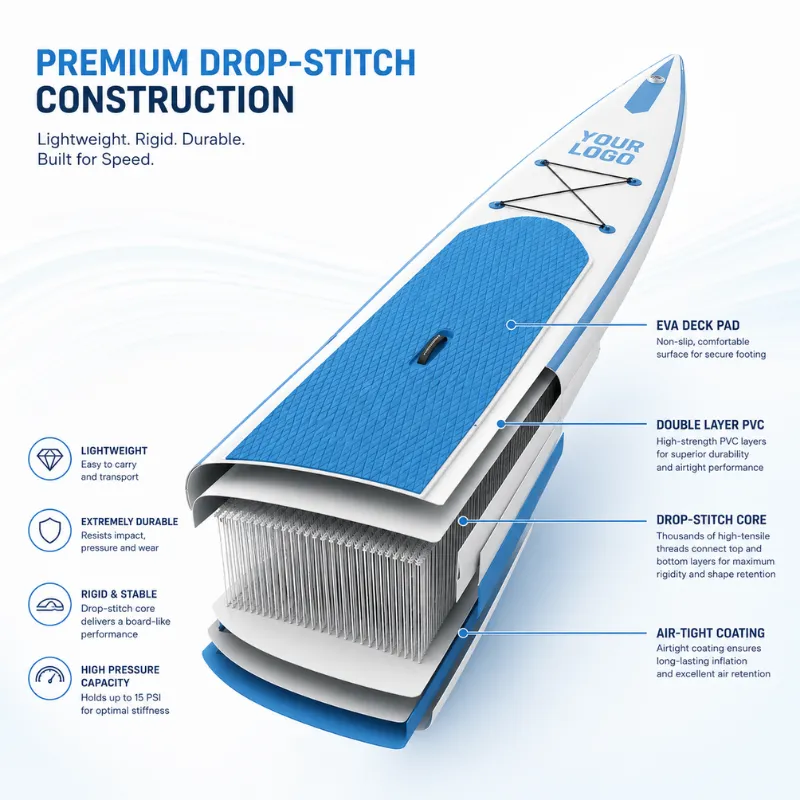
Drop stitch technology is a specialized construction method that connects the top and bottom layers of an inflatable board using thousands of high-strength polyester threads.


When the board is inflated, these threads prevent the two surfaces from bulging outward.
Instead of forming a rounded tube, the board maintains a flat and rigid shape similar to a hard board.
Without drop stitch technology, inflatable paddle boards would be soft, unstable, and unsuitable for standing.
How Does Drop Stitch Construction Work?
The construction process typically involves:
1. Creating the Drop Stitch Core
Thousands of polyester threads are woven between two layers of fabric.
The thread density can range from several thousand to tens of thousands of threads per square meter.
Higher thread density generally results in:
- Better rigidity
- Improved shape retention
- Higher pressure capacity
2. Laminating PVC Layers
Multiple layers of reinforced PVC are bonded to the drop stitch fabric.
Manufacturers may use:
- Single-layer PVC
- Double-layer PVC
- Fusion laminated PVC
Premium boards often use fusion technology because it reduces weight while maintaining strength.
3. Heat Welding or Gluing
The side rails are sealed using advanced welding or adhesive processes.
High-quality welding improves:
- Air retention
- Durability
- Long-term reliability
4. High-Pressure Inflation
Most inflatable SUP boards operate between:
- 12 PSI – 15 PSI (recreational use)
- 15 PSI – 20 PSI (performance boards)
The internal drop stitch threads become fully tensioned during inflation, creating exceptional rigidity.
Why Is Drop Stitch Technology Important?
Increased Rigidity
Rigidity is the most important factor in paddle board performance.
A rigid board provides:
- Better balance
- Improved tracking
- More efficient paddling
- Greater speed
Modern drop stitch boards can achieve stiffness levels that closely resemble hard boards.
Lightweight Design
Despite their strength, drop stitch boards remain lightweight.
Benefits include:
- Easy transportation
- Convenient storage
- Lower shipping costs
- Better portability for travelers
Excellent Durability
The combination of reinforced PVC and high-strength internal threads creates a structure that can withstand:
- UV exposure
- Repeated inflation cycles
- Heavy rider loads
- Marine environments
Compact Storage
Unlike rigid epoxy boards, inflatable SUPs can be deflated and rolled into a backpack.
This makes them ideal for:
- Travelers
- Apartment owners
- Rental businesses
- Outdoor enthusiasts
Single Layer vs Double Layer Drop Stitch Construction
Single Layer Construction
Advantages:
- Lower cost
- Lightweight
- Easy handling
Disadvantages:
- Less rigid
- Reduced durability
Best for:
- Entry-level users
- Casual recreation
Double Layer Construction
Advantages:
- Greater stiffness
- Better durability
- Longer lifespan
Disadvantages:
- Slightly heavier
- Higher manufacturing cost
Best for:
- Serious paddlers
- Rental fleets
- Commercial applications
Fusion Drop Stitch Technology
Modern manufacturers increasingly use fusion construction.

Fusion technology uses heat and pressure to bond materials instead of relying solely on adhesives.
Advantages include:
- Reduced weight
- Improved consistency
- Better environmental performance
- Stronger material bonding
Many premium inflatable SUP brands now utilize fusion laminated drop stitch technology.
How Manufacturers Evaluate Drop Stitch Quality
When sourcing inflatable SUP boards, buyers should consider:
Thread Density
Higher density generally means greater rigidity.
PVC Material Quality
Look for military-grade reinforced PVC.
Manufacturing Process
Heat-welded seams often outperform traditional glued seams.
Pressure Rating
A quality board should comfortably handle at least 15 PSI.
Quality Control
Professional manufacturers typically conduct:
- Air leakage testing
- Pressure testing
- Visual inspection
- Seam integrity testing
Know more about Verda, and our quality control
The Future of Drop Stitch Technology
As manufacturing techniques continue to evolve, drop stitch technology is becoming:
- Lighter
- Stronger
- More sustainable
- More cost-effective
Innovations in fusion lamination and woven drop stitch fabrics are helping manufacturers produce inflatable boards that perform closer than ever to traditional hard boards.
Conclusion
Drop stitch technology is the key innovation that makes inflatable SUP boards possible. By connecting the top and bottom layers with thousands of internal threads, manufacturers create lightweight boards that deliver impressive rigidity, durability, and portability.
Whether you’re a paddling enthusiast, distributor, rental operator, or brand owner, understanding drop stitch technology can help you make better decisions when selecting high-quality inflatable paddle boards.